
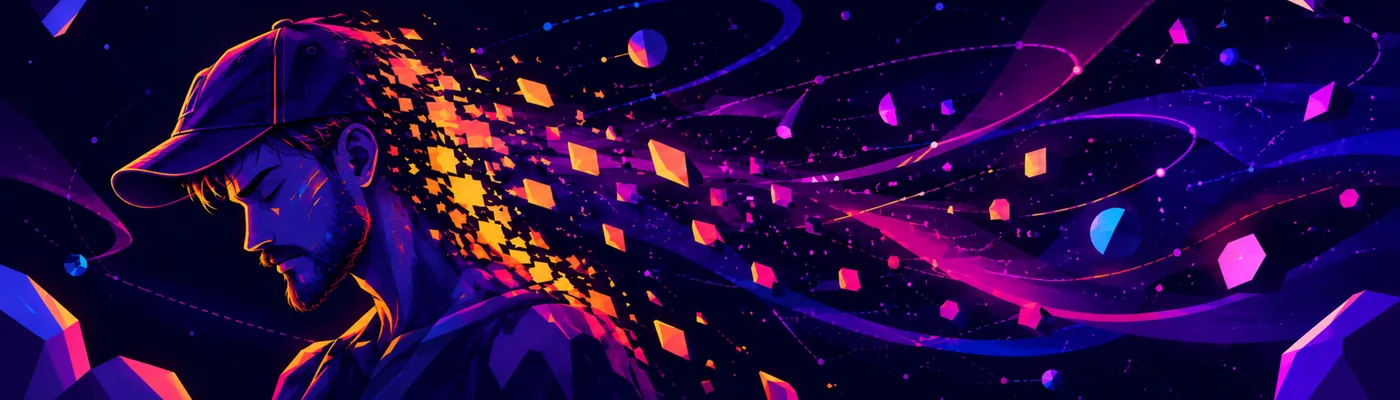
Who am I? I don’t really know. Someone lost in space and time, trying to understand what it means to be here. I know my name, what I do, what I’ve lived through. But I still struggle to explain who I am. Somewhere in trying to understand everything around me, I’m trying to understand myself.
Space fascinates me because of how far it stretches my ability to imagine anything. Light travelling for millions of years. Stars whose deaths we haven’t seen yet. Black holes, the beginning of the universe, and whatever might exist beyond what we can observe. I find myself wondering what time actually is, whether a beginning requires something before it, and how much of reality we’ll never have access to.
Physics takes that curiosity deeper. I want to understand what matter is doing underneath the world we experience, how gravity works, why particles behave the way they do, and how the same universe can produce both something predictable and something deeply counterintuitive. I’m fascinated by how we manage to investigate any of this, how an observation becomes an idea, then a calculation, then something we can test.
I believe learning more about religion and science enhances my understanding of both, each giving me more to consider about the other.
Logic and mathematics draw me in because I want to follow the reasoning for myself. What assumptions are we making? Does the conclusion actually follow? What would prove it wrong? Probability interests me because intuition can feel completely convincing while leading us in the wrong direction. I want to recognise where my own thinking fails, even when the answer is uncomfortable.
The human brain brings those questions closer to home. It’s strange to think that the thing trying to understand the universe is also something we’re still trying to understand. How do neurons working together produce memory, perception, emotion, and a sense of self? How does an experience change the brain? How does something that happened years ago still affect a reaction today?
I wonder how much of what I experience is the brain interpreting and reconstructing things. Whether the world feels the same to someone else. How much happens before I become consciously aware of a decision, and how much of the explanation I give myself comes afterwards.
That connects to my interest in psychology. I want to understand attachment, fear, grief, habits, and the reasons people repeat behaviours they know will hurt them. I wonder how much of who we become grows around what we’ve experienced, especially what we’ve had to survive. I’m part of those questions too.
AI gives me another way to explore learning and intelligence. I want to get inside how neural networks work: how they represent information, how a prediction produces an error, and how changing their weights can improve what they do. Gradient descent, backpropagation, reinforcement learning. I want to follow those processes closely enough to understand what is happening and build something myself.
I’m curious about the relationship between artificial networks and biological brains, including where the similarities end. How far can learning from patterns take a system? What allows it to apply something learned in one situation to another? What would justify saying it understands? The possibility of machine consciousness leaves me wondering how we would recognise it, given how difficult consciousness already is to explain in ourselves.
There’s a practical side to all of this. I like building systems, taking them apart, running things myself, and finding out why they fail. Infrastructure, networks, Linux, security, local AI. I want to understand the dependencies and the failure points. Getting something working is satisfying; understanding why it works gives me something I can carry into the next problem.
Survival interests me at both a biological and a personal level. How does life adapt? What keeps a person functioning when the life they knew has fallen apart? What happens to judgement and identity under enough pressure? I wonder how much of our behaviour still follows the need to protect ourselves, even when we struggle to recognise what we’re protecting ourselves from.
The afterlife makes some of these questions deeply personal. Having lost people I love, I think about what continues beyond this life, what happens to consciousness, and what it would mean to see them again. I’m left wondering about everything that made them who they were, their memories, their thoughts, their experience of being alive.
I don’t have a complete answer to who I am. These are the things my mind keeps returning to. The universe outside me, the brain making sense of it, and the strange fact that I get to experience any of this at all. I’m still someone lost in space and time. I want to understand as much as I can while I’m here.
Who am I? I don’t really know. Someone lost in space and time, trying to understand what it means to be here. I know my name, what I do, what I’ve lived through. But I still struggle to explain who I am.
My mind keeps wandering towards things I can barely comprehend: the scale of the universe, the nature of time, consciousness, what happens after we die. Somewhere in trying to understand existence, I’m trying to understand myself.
Space fascinates me. I try to imagine the distances, the time, the fact that light can travel for millions of years before reaching my eyes. Entire stars can disappear while their light is still on its way to us. I wonder what exists beyond what we can observe, how much we’ll ever understand, and how strange it is that I get to spend any time here at all.
Physics gives that curiosity somewhere to go. Gravity, matter, energy, probability, the way time itself behaves. I want to understand how these things fit together and how we’ve managed to work any of it out. Sometimes the explanation is stranger than anything I could have imagined. That makes me want to keep going.
I believe learning more about religion and science deepens my understanding of both, each enriching how I understand the other.
Logic matters to me. I want to understand how a conclusion was reached, what supports it, and whether it still holds when questioned. I also know I’m capable of convincing myself of something because I want it to be true. Recognising that in myself is harder than spotting it in someone else.
The human brain fascinates me for the same reason. Somehow, this physical organ produces my experience of being me. It holds memories, recognises voices, creates dreams, anticipates danger. A piece of music can change how I feel within seconds. A memory can bring back an emotion with a force I wasn’t prepared for. I want to understand how that happens, how experience changes the connections between neurons, and how much takes place before I’m even consciously aware of it.
Then there’s psychology. Why do we repeat things that hurt us? Why do we become attached to particular people? How can two people live through the same event and carry completely different versions of it? I wonder how much of my personality comes from deliberate choices and how much grew around things I had to survive.
AI brings another set of questions into that curiosity. I want to understand how artificial neural networks learn, how adjusting connections across a system allows it to recognise patterns, generate language, or solve a problem. I’m interested in what those networks share with biological brains and where the comparison stops being useful. What does it mean for a machine to understand something? What would count as evidence of consciousness? How would we even recognise an experience we couldn’t access directly?
Survival interests me too. What keeps someone going when the life they knew has fallen apart? What happens to reason, identity, and principles under enough pressure? We carry this instinct to stay alive alongside the knowledge that our lives will end. I wonder how much of what we build, pursue, and believe is shaped by that tension.
The afterlife makes those questions personal. Having lost people I love, I think about what might continue beyond this life, what happens to consciousness, and what it would mean to see them again. Sometimes an ordinary memory brings all of that back. I’m left wondering where everything that made a person who they were has gone.
Music is part of how I live with these thoughts. Certain songs hold entire periods of my life. I remember who was there and how ordinary those days felt before everything changed. Playing guitar or trying to create an image gives me somewhere to put feelings I struggle to explain.
And I still get absorbed in games, laugh at ridiculous things, and get excited about something new I want to learn. Those moments belong to me as much as the heavier ones.
I don’t have a complete answer to who I am. I’m curious, sometimes overwhelmed, and aware that I’ll never get through all my questions. For now, I’m someone here, in this brief stretch of space and time, trying to understand what I can.